Ecthyma
| Ecthyma | |
|---|---|
.jpg) | |
| Ecthyma | |
 | |
| Specialty | Dermatology |
| Symptoms | Well-defined deep ulcers with dead tissue, covered with crusts and fluid[1] |
| Complications | Ecthyma gangrenosum[2] |
| Causes | Group A (beta-hemolytic) Streptococcus, Staph. aureus[2] |
| Risk factors | Malnutrition, poor hygiene[2] |
| Treatment | Applying antiseptics, better nutrition and hygiene,[2] soap and water[1] |
| Medication | Antibiotics: applying fusidic acid or mupirocin ointments, flucloxacillin or dicloxacillin by mouth[3] |
| Prognosis | Heals leaving a scar[1] |
Ecthyma is an ulcerative type of impetigo.[4] It typically presents as well-defined deep ulcers with dead tissue, covered with crusts and fluid.[1]
The condition is generally caused by the bacteria Group A (beta-hemolytic) Streptococcus (GAS), Staph. aureus, and sometimes both.[2] It is associated with poor hygiene and poor nutrition.[2] Ecthyma gangrenosum is a more severe type caused by Pseudomonas septicaemia.[2] The very young, elderly and those with weakened immune systems are more susceptible to ecthyma.[3]
Treatment requires antibiotics, applying antiseptics and improving hygiene and nutrition.[2] Fusidic acid or mupirocin ointments can be applied three times daily to the ulcers, after removing the crusts.[3] Crusts can be removed by applying gentle pressure for 10-minutes at a time, several times a day, with a cloth soaked in a mixture of half a cup of white vinegar in a litre of water.[3] Other options include applying antiseptics such as povidone iodine, superoxidised solution, antibacterial Manuka honey or hydrogen peroxide cream.[3] Flucloxacillin or dicloxacillin can be given by mouth.[3]
The condition occurs in all ages, and in both males and females.[3]
Signs and symptoms
-
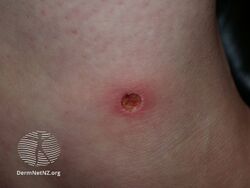
Ecthyma
-
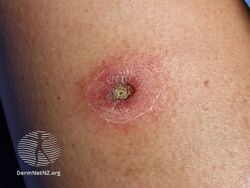
Ecthyma
-
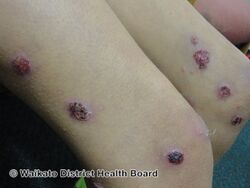
Ecthyma
.jpg)
.jpg)
.jpg)
References
- ↑ 1.0 1.1 1.2 1.3 James, William D.; Elston, Dirk; Treat, James R.; Rosenbach, Misha A.; Neuhaus, Isaac (2020). "14. Bacterial infections". Andrews' Diseases of the Skin: Clinical Dermatology (13th ed.). Edinburgh: Elsevier. p. 259. ISBN 978-0-323-54753-6. Archived from the original on 2023-05-16. Retrieved 2023-06-29.
- ↑ 2.0 2.1 2.2 2.3 2.4 2.5 2.6 2.7 Wakelin, Sarah H. (2020). "22. Dermatology". In Feather, Adam; Randall, David; Waterhouse, Mona (eds.). Kumar and Clark's Clinical Medicine (10th ed.). Elsevier. p. 670. ISBN 978-0-7020-7870-5.
- ↑ 3.0 3.1 3.2 3.3 3.4 3.5 3.6 Ngan, Vanessa (January 2016). "Ecthyma. DermNet NZ". dermnetnz.org. Archived from the original on 2016-07-10.
- ↑ Stevens, Dennis L.; Bryant, Amy E.; Hagman, Melissa M. (2020). "274. Nonpneumococcal streptococcal infections and rheumatic fever". In Goldman, Lee; Schafer, Andrew I. (eds.). Goldman-Cecil Medicine. Vol. 2 (26th ed.). Philadelphia: Elsevier. p. 1873. ISBN 978-0-323-55087-1. Archived from the original on 2023-04-09. Retrieved 2023-06-29.
External links
| Classification | |
|---|---|
| External resources |